
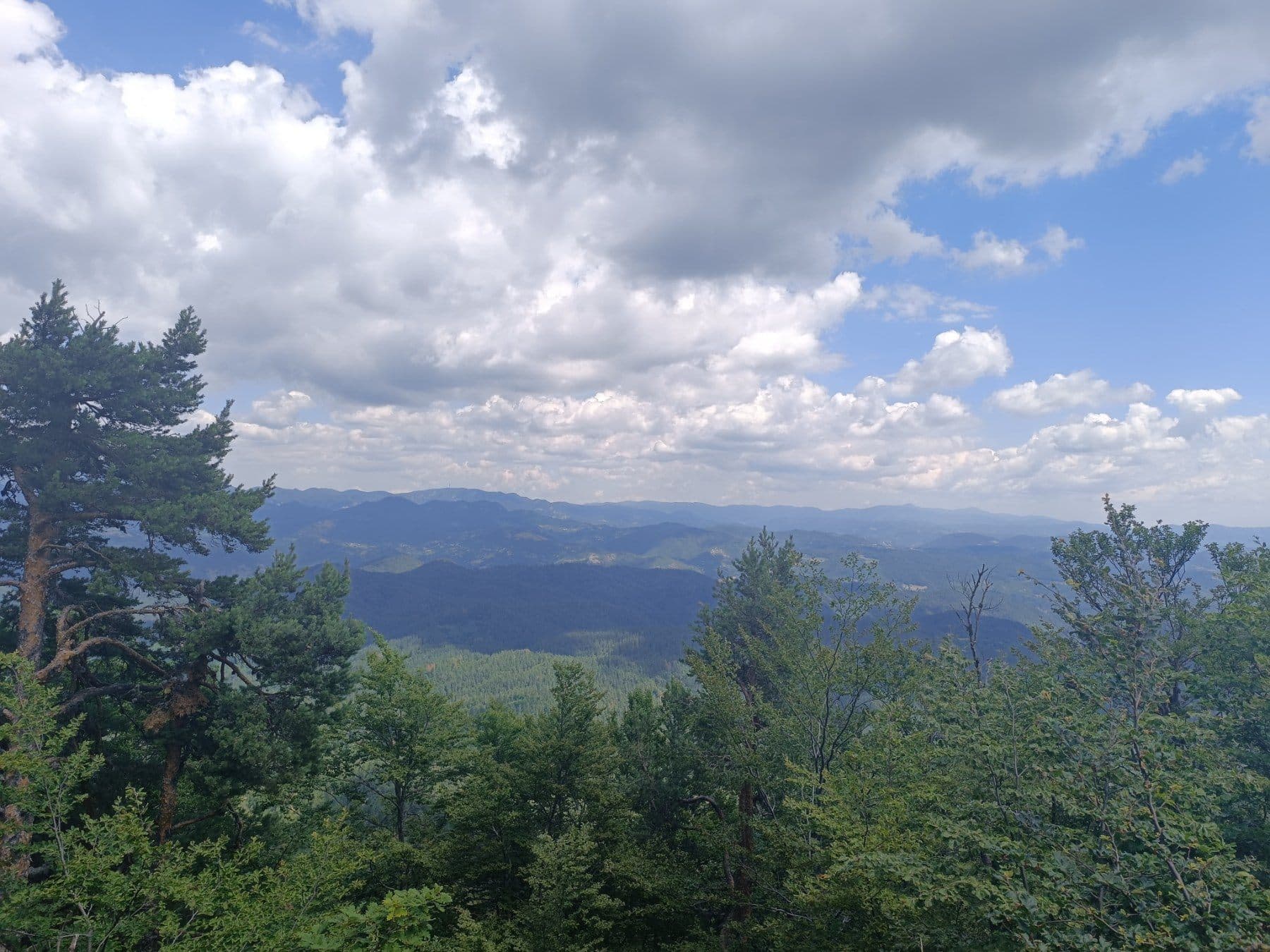
The village of Mogilitsa sits in the Upper Arda valley, in the eastern part of the Western Rhodopes, 26 km south of the town of Smolyan and a few kilometres from the Greek border. At 960 m above sea level, it is high enough to feel like the mountains proper, but it is not hard to reach.
This is a plain guide to working out how to get to the Rhodope Mountains from wherever you are starting: which airport to fly into, how the drive splits into a fast half and a slow half, and how to arrange things so that you never have to drive a mountain road on the day you land.
Which airport to fly into
Sofia (SOF) is Bulgaria’s principal international gateway and the airport almost everyone should aim for. It has the widest choice of flights, the most car hire desks, and the best onward connections, and it is the starting point for the drive we describe below.
Plovdiv (PDV) is a much smaller airport that mainly handles seasonal low-cost routes and winter charter flights. If your dates happen to line up with a Plovdiv service it can save you an hour or more of driving, because Plovdiv is already at the foot of the Rhodopes. Treat it as a useful extra rather than something to plan the whole trip around, and check Sofia first.
Connecting flights for long-haul travellers
There are no direct transatlantic flights to Bulgaria, so if you are coming from North America or Australia you will change planes once in Europe. The usual connecting hubs are Frankfurt, Munich, Vienna, Istanbul and London, all of which have frequent onward flights to Sofia.
Book the whole journey on a single ticket where you can. That keeps your bags checked through to Sofia and protects your connection if the first leg runs late. Give yourself a sensible layover at the hub, particularly if you are changing terminals or clearing passport control there.
The drive from Sofia in two parts
The journey from Sofia to Mogilitsa falls neatly into two halves, and it helps to picture them separately. The first half is fast and easy. The second half is slow and scenic. Allow around four hours in total, plus stops.
The first part runs from Sofia to Plovdiv, roughly 150 km and about an hour and a half on the A1 Trakia motorway. It is a straightforward stretch of dual carriageway, so you cover ground quickly and can settle in after the flight.
The second part is where the character changes. From Plovdiv the road climbs into the Rhodopes and slows down, winding up and over the range, down through Smolyan and on to Mogilitsa. It is a beautiful drive and a genuinely mountain one, with bends and gradients, so plan for a slower pace than the map distance suggests and do not rush it.
Let a guide collect you, or hire a car
You have two clear ways to cover that route, and which suits you depends mostly on how you feel about driving a mountain road on arrival day.
The local society, Krepostta - Mogilitsa, runs guides who speak English and can collect visitors if it is arranged in advance. That removes the one part of the trip that gives newcomers pause: the twisting section between Plovdiv and Mogilitsa. You land, you are met, and someone who knows the road drives it while you look out of the window.
- A guide pickup can be arranged from Sofia, Plovdiv, Smolyan or your guesthouse, all set up beforehand.
- Hiring a car gives you freedom to explore the valley and the wider Rhodopes at your own pace once you have arrived.
- A common middle path: hire a car for daily freedom but ask about a pickup for arrival day, so your first drive is not the mountain leg while jet-lagged.
- Non-EU licence holders should carry an International Driving Permit alongside their home licence if they intend to drive.
Money, entry and the small practical stuff
Bulgaria adopted the euro on 1 January 2026, so you will be paying in the same currency used across much of the continent and there is no separate money to change. The national language is Bulgarian, but the society’s guides speak English, which makes arranging a pickup or asking questions straightforward.
Bulgaria is in the EU and the Schengen area. Visitors from the US, Canada, the UK and Australia can enter visa-free for up to 90 days in any 180. The EU’s ETIAS travel authorisation is expected to begin later in 2026, so check its status close to your trip and apply online if it is in force by then.
A few odds and ends worth knowing: plug sockets are the European Type C and F round-pin kind at 230V, so bring the right adapter, and crime is low, so this is a comfortable region to travel in.
Putting it together
For most international visitors the simplest plan is: fly into Sofia, connecting via a European hub if you are coming from far away, then cover the four-hour drive to Mogilitsa either behind the wheel of a hire car or with a guide at the wheel.
If the idea of the mountain road puts you off, that is exactly the problem the pickup solves. Get in touch ahead of time, tell the society your arrival airport and date, and the hardest part of getting to the Rhodope Mountains is handled before you even take off.
Common questions
- What is the best airport for reaching Mogilitsa and the Rhodope Mountains?
- Sofia (SOF) is the main choice. It is Bulgaria’s principal international gateway, with the most flights, car hire and connections, and it is the start of the roughly four-hour drive to Mogilitsa. Plovdiv (PDV) is a smaller option with mainly seasonal and winter charter flights, and it is closer to the mountains if your dates suit it.
- How long does the drive from Sofia take?
- Allow around four hours in total. The first part, Sofia to Plovdiv, is about 150 km and an hour and a half on the A1 Trakia motorway. The second part climbs into the Rhodopes and down through Smolyan to Mogilitsa, and it is slower and more winding, so leave extra time.
- Can someone pick me up so I do not have to drive?
- Yes. The local society, Krepostta - Mogilitsa, has English-speaking guides who can collect you from Sofia, Plovdiv, Smolyan or your guesthouse if you arrange it in advance. That means you avoid driving the mountain road on your arrival day.
- Do I need a visa, and what currency is used?
- Visitors from the US, Canada, the UK and Australia can enter visa-free for up to 90 days in any 180, as Bulgaria is in the EU and Schengen. The EU’s ETIAS authorisation is expected later in 2026, so check before you travel. Bulgaria uses the euro, adopted on 1 January 2026.
- Are there direct flights from North America or Australia?
- No. There are no direct transatlantic flights to Bulgaria, so you connect once through a European hub such as Frankfurt, Munich, Vienna, Istanbul or London, then fly on to Sofia. Booking the full journey on one ticket keeps your bags checked through and protects your connection.